
The Gray Market: Why the Super Bowl Helps Explain the Flaws in the Latest ‘Salvator Mundi’ Scandal (and Other Insights)
Every Monday morning, Artnet
News brings you The Gray Market. The column decodes important stories from the
previous week—and offers unparalleled insight into the inner
workings of the art industry in the process.
This week, questioning the
entire premise of a supposed art-market controversy…
LORD, SAVE US
On Wednesday, Dalya Alberge of
the Guardian pulled together the prickly threads of
a(nother) scandal regarding Leonardo da Vinci’s
Salvator
Mundi, the endlessly
news-making, endlessly disputed painting that has been absent from
public view since it sold for over $450
million at Christie’s New York in November 2017. Rather than
fixating on its whereabouts, the newly surfaced conflict concerns
an older chapter in the work’s colorful history. But even after
turning back the clock a few years, I think the drama is still
comically out of step with the long-established realities of the
international art trade.
The clash concerns whether or
not Salvator
Mundi was actively being offered
to potential buyers while it was on view in a Leonardo survey
at London’s National Gallery between November 2011 and February
2012. Old Master dealer Robert Simon, who then co-owned the work
with dealer Alex Parish and assorted others, stated in a press
release a few months prior to the show’s debut that
Salvator Mundi
was “privately owned and not for
sale”—a policy that would satisfy what the Guardian terms the “unwritten rule” that public
collections should refrain from exhibiting works available on the
open market.
Simon recently doubled down on
his claim in the London
Review of Books after
art historian Charles Hope published a lengthy piece implying
otherwise in the publication’s January issue. Although the main
thrust of Hope’s missive is to attack the painting’s attribution to
Leonardo, his critique also includes a pointed description of the
work as “supposedly not for sale” just before alleging that Simon
and Parish “began to look for buyers soon after the exhibition
closed,” based on fellow art historian Ben Lewis’s Salvator
Mundi-dissecting book The Last Leonardo.
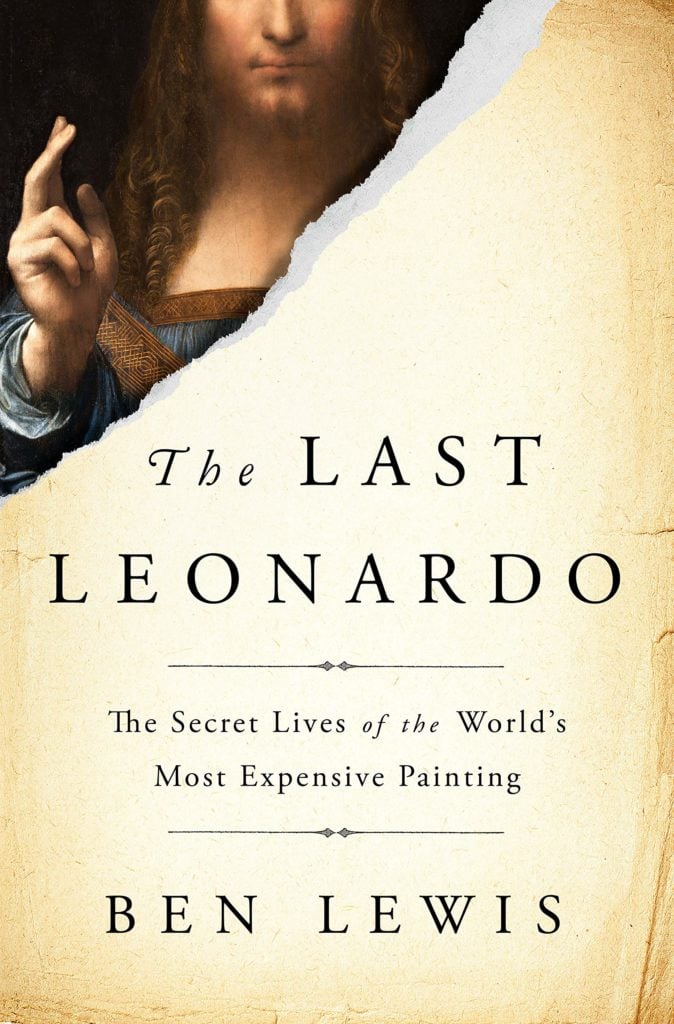
Art historian Ben Lewis’s book The
Last Leonardo. Courtesy of Amazon.
The “bitter row,” to quote
the Guardian, escalated further last
Wednesday, when Lewis himself wrote his own letter to the London Review of Books claiming evidence that the painting had been
shopped for more than a year prior to the National Gallery
exhibition, in addition to immediately after it. If true, his
contention would mean that Salvator Mundi had been on offer for all but the four months
it was on public view in London… which would also suggest to anyone
who believes humans are even slightly less than wingless angels
that the painting was on the market during the National Gallery’s
exhibition, too.
Here’s what I initially found
both hilarious and baffling about the outraged reaction to these
revelations, though. As Hope admits, it was public knowledge by
2011 that Salvator
Mundi was owned by a
consortium of Old Master dealers led by Simon.
Let me repeat that: we knew the
painting was owned by dealers.
So of course it was available
while the show was going on! Why on earth would anyone familiar
with the concept of an art dealer need specific evidence suggesting
the painting was offered before and after the exhibition in order
to land on that conclusion? Expecting anything else would be like
giving a fur trapper a “pet” chinchilla and being surprised when
they turn its pelt into a hat. The job is the job,
folks.
But I don’t think Simon is lying
when he states that Salvator Mundi was, officially speaking, not for sale during
its four months hanging in the National Gallery, either. (He
told Artnet News: “I
can state absolutely, categorically, without any doubt,
prevarication, or question, that the Salvator
Mundi was not for sale, actually, effectively, or
implicitly, at the time of the Leonardo exhibition at the National
Gallery.”)
But maybe it’s a
misunderstanding of the for-sale/not-for-sale paradox that is
responsible for what strikes me as an unnecessarily scandalized
response to the news from various corners of the art world.
The key point is this: In the
international art market, especially the upper reaches of the
resale market, “not for sale” is a bargaining
position—whether the party
voicing those three magic words intends to stand by them in the
moment or not. This means it can be literally true and
substantively false at the same time. And this has been the case
for at least the past 30 years, if not longer.
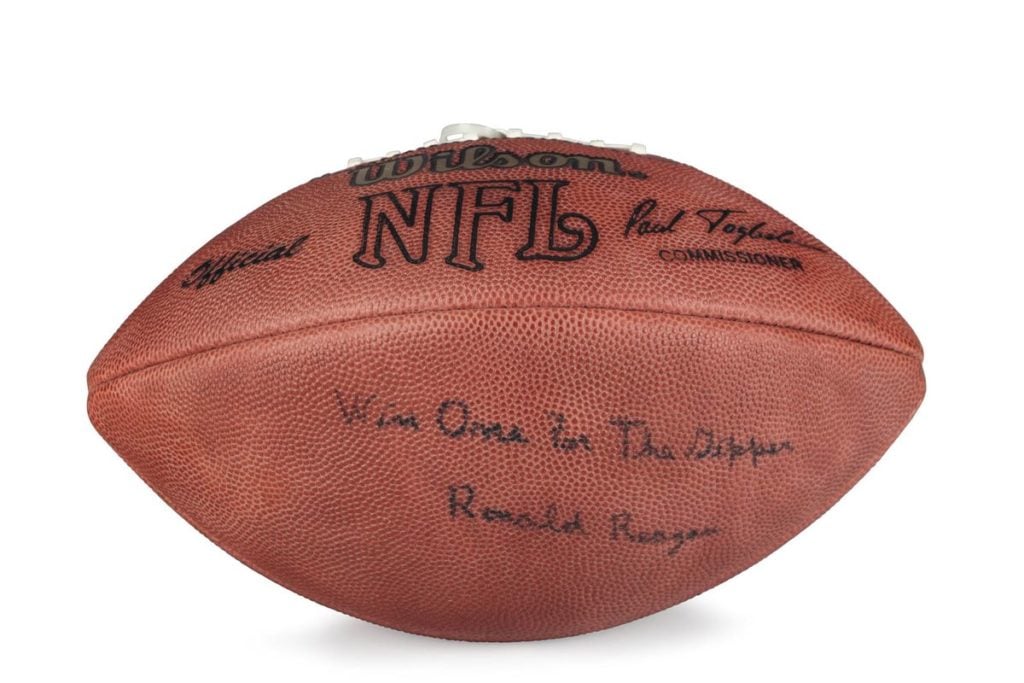
This Ronald Reagan-signed football sold
for $93,750 on estimate of $5,000–10,000. Courtesy of
Christie’s.
MANUFACTURING A MARKET
Now, I may only have had this
thought because the Super Bowl was this weekend, but an American
football analogy helps explain what I see as the crux of this
latest clash over Salvator Mundi.
NFL fans are familiar with the
concept of a quarterback “throwing a receiver
open.” For the
uninitiated, the idea is that one player advances the ball upfield
by rifling it into a spot that only his teammate can reach, even if
a defender is doing an excellent job of covering that teammate. The
secret? The throw’s placement forces the receiver to move away from
his current position. If the quarterback accepted the circumstances
as they were instead of taking action to change them, the gain
wouldn’t materialize.
The reality is that the most
ambitious art dealers do the mercantile equivalent of “throwing
receivers open” all the time. In fact, this strategy was more or
less pioneered by Larry Gagosian when he took over the resale
market in the 1980s: Gagosian sold works available.
What does that mean? Consider
this excerpt from Michael Shnayerson’s Boom, which charts the rise of the contemporary art
market in New York from the postwar era to the present:
Gagosian rarely waited to
hear that a collector was putting a painting up for sale. He cadged
invitations to collectors’ homes, memorized the paintings on their
walls, and on occasion—or so it was said… took surreptitious
snapshots of them. Then he called other collectors who might want
to buy them. How much would the prospective buyer pay? $20,000?
Back he went to the unwitting seller to announce that if he was
willing to part with the painting in question, Gagosian had a buyer
who would pay $20,000 for it. No? Not enough? What would it take,
then, for the now-witting seller? $30,000? Back went Gagosian to
the buyer….
In other words, Gagosian
regularly shook loose pieces that were “not for sale” by
understanding that, in principle, “not for sale” is just a synonym
for “better offer required.” The stance is just as effective if
it’s sincere or if it’s a total bluff. Grasping this lesson was one
of Gagosian’s keys to becoming the ruler of the resale market
decades ago, and it’s been a page in the playbook for every dealer
since.
Despite being a crass American
millennial, then, I understand the previously mentioned custom that
works exhibited in public institutions should not be for sale. I
just think it’s naive at this point in history. Galleries regularly
underwrite museum exhibitions and actively sell what’s on view inside them.
Biennials, once walled off from commerce, have been high-art
shopping malls for years. Even if a dealer adheres to the letter of
the unwritten rule by refusing to initiate or finalize the sale of
a work while it’s on view, that doesn’t mean the display can’t
still be a crucial plank in the sales strategy.
(And by the way, if most viewers
believed this alleged conflict of interest was a genuine problem,
legislators would be pushing for a dramatic increase in public arts
funding instead of the opposite. So don’t blame starving
institutions for accepting private largesse and programming their
slates with potentially-for-sale artworks that they hope will
maximize attendance, particularly if you don’t want them to use
their endowments for operational expenses.)
To me, this is why it’s silly to
be scandalized by the details of who did, or did not, offer
Salvator Mundi
to whom at what time vis-à-vis the
National Gallery show, especially nearly a decade after the fact.
No matter what Simon and company said or meant in 2011, it was
available then. I’d also argue it’s available right now (assuming
it’s intact). It’s always
available, because
that’s how the market works. It’s just a matter of whether someone
has made the right offer yet—or whether the right dealer has
managed to generate it. And if you’re unhappy about what that means
for institutional exhibitions, the only thing that could reverse
the situation now is divine intervention.
That’s all for this week. ‘Til
next time, remember: whether we’re talking about the art market or
high crimes and misdemeanors, circumstances can make almost any
rule open to interpretation.
The post The Gray Market: Why the Super Bowl Helps Explain
the Flaws in the Latest ‘Salvator Mundi’ Scandal (and Other
Insights) appeared first on artnet News.
Read more https://news.artnet.com/opinion/gray-market-salvator-mundi-not-for-sale-1767888
Further reading


Leave a comment