
Painter Mary Abbott, a Fixture of New York’s Abstract Expressionist Movement, Has Died at Age 98
Abstract Expressionist painter Mary Abbott, known for her colorful
canvases and sweeping brushstrokes, has died at the age of 98.
McCormick Gallery in Chicago, which has represented the artist for
almost 20 years, said the cause of death was heart failure.
In 2008, the New York Times
praised Abbott as “one of the last great Abstract Expressionist
painters of her generation.” Nevertheless, Abbott’s work received
little scholarly recognition until 2016, when the Denver Art Museum organized the exhibition
“Women of Abstract
Expressionism,” which traveled to the Mint Museum in North
Carolina and the Palm Springs Art Museum in California.
Abbott’s work was shown alongside that of 11 other women who
were among the pioneers of the Ab Ex movement in the late 1940s and
’50s, including better-known figures such as Lee Krasner, Helen Frankenthaler, Elaine de Kooning, Joan Mitchell, and Grace Hartigan. One of just three
living artists in the show, Abbott spoke on the occasion about what
drew her to abstract painting. “It just hit me. I just liked it,”
she said in a video produced by the museum. “Trying to do things
representationally didn’t work for me. [With abstraction] I could
talk in a different way.”
Abbott was born in 1921 to Henry Livermore Abbott and Elizabeth
Grinnell, members of New York’s social elite. Her family was
descended from President John Adams, and counted the Roosevelts as
close friends. As a young socialite in the early 1940s, she
appeared on the cover of Vogue, launching a brief modeling
career with further covers for Charm, Harper’s
Bazaar, and Glamour. At the same time, Abbott was taking
classes at New York’s Art Students League and the Corcoran Museum
School in Washington, DC.
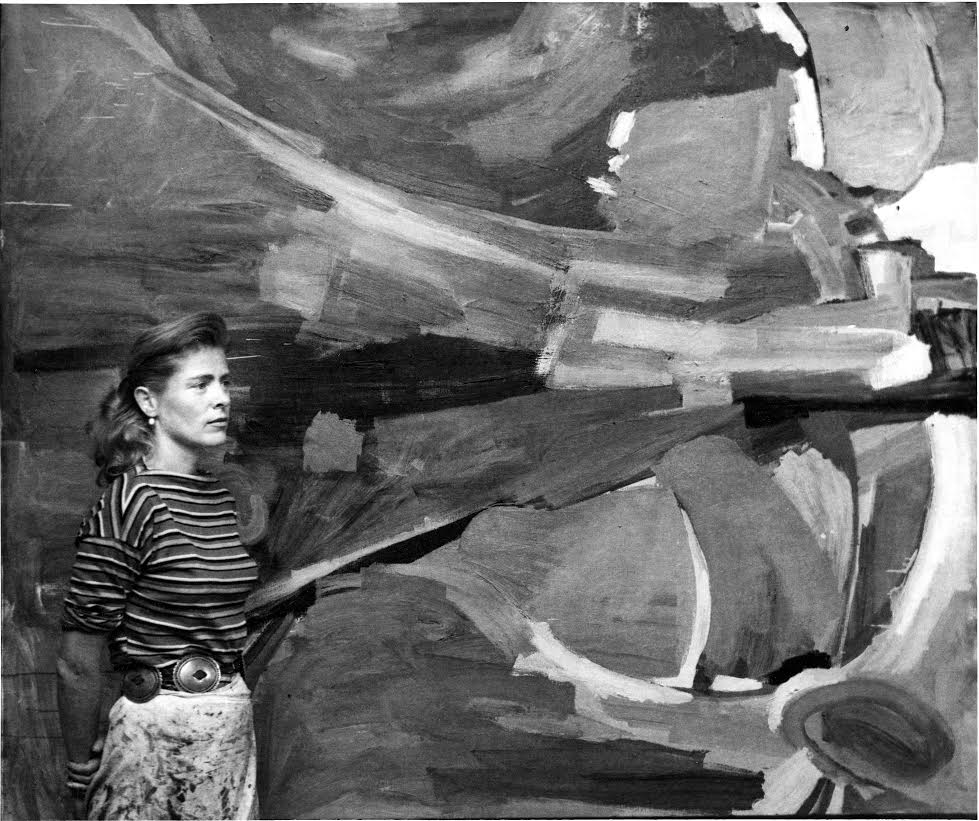
Mary Abbott in her studio (circa 1950).
Photo courtesy of McCormick Gallery, Chicago.
Following a brief marriage to painter Lewis Teague, from 1943 to
1946, Abbott made the decision to eschew the trappings of her
privileged upbringing. She separated from her husband and moved to
a cold water flat on 10th Street, immersing herself in the downtown
scene, thanks in part to introductions from her friend, painter
David Hare.
Soon a fixture at New York’s Cedar Street Tavern, where the Ab
Ex cohort hung out, Abbott was one of the few women members of the
club. She studied with Mark Rothko, Barnett Newman, and Robert
Motherwell, and was also a lifelong friend of Willem de Kooning.
Some observers, including art collector Asher Edelman, have argued
that Abbott’s paintings inspired the older artist’s renowned
landscapes, begun five years after hers.
Abbott met her second husband, Tom Clyde, while in finalizing
her divorce from Teague in 1949. The two married the next year and
moved to Southampton, New York. Because Clyde had chronic back
problems, the couple began taking annual winter trips to to Haiti
and the Virgin Islands, which greatly influenced Abbott’s work.
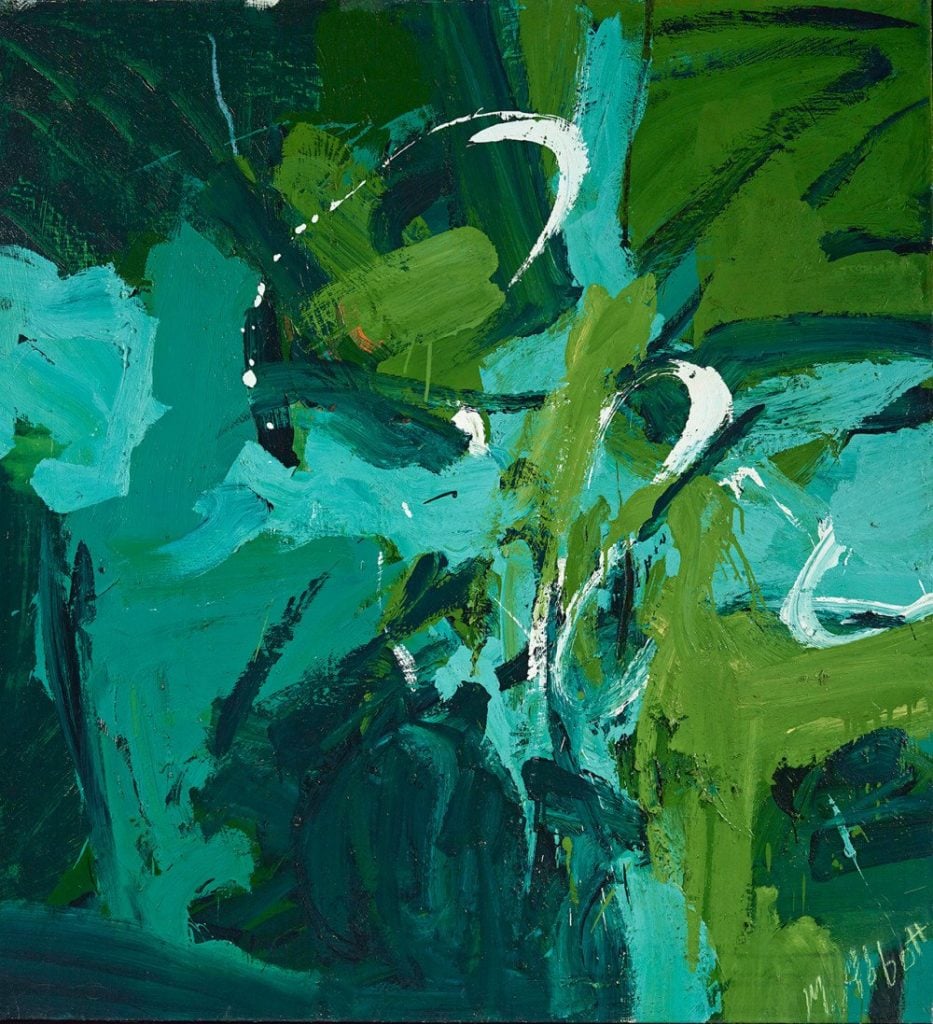
Mary Abbot, All Green (1954).
Courtesy of the Denver Art Museum, gift of Janis and Tom McCormick,
©Mary Abbott.
“It was in the islands that Abbott’s work began to truly
flourish,” McCormick Gallery said in a statement. “She was
enthralled by the mountain landscape and the village markets. She
had always felt that she was part of nature, and the immersion into
the Haitian jungle suited her perfectly.” Gallery owner Tom
McCormick called her “a great lady and amazing painter.”
Abbott was included in “Recent Drawings U.S.A.” at New York’s
Museum of Modern Art in 1956. She also exhibited downtown at the
Tanager Gallery, Kootz Gallery, Tibor de Nagy Gallery, and the
annuals at the Stable Gallery. In 1958, she created a series of
“Poetry Paintings” in collaboration with poet Barbara Guest, which
appeared at New York’s Kornblee Gallery alongside work by Frank
O’Hara, Kenneth Koch, and Larry Rivers.
In 1966, Abbott and Clyde divorced. After spending most of the
1970s teaching at the University of Minnesota in Minneapolis, she
returned to New York and bought an apartment in the city and a
house in Southampton, where she kept a studio in an abandoned ice
house. Abbott split her time between the two properties up until
giving up her Soho loft about a decade ago.
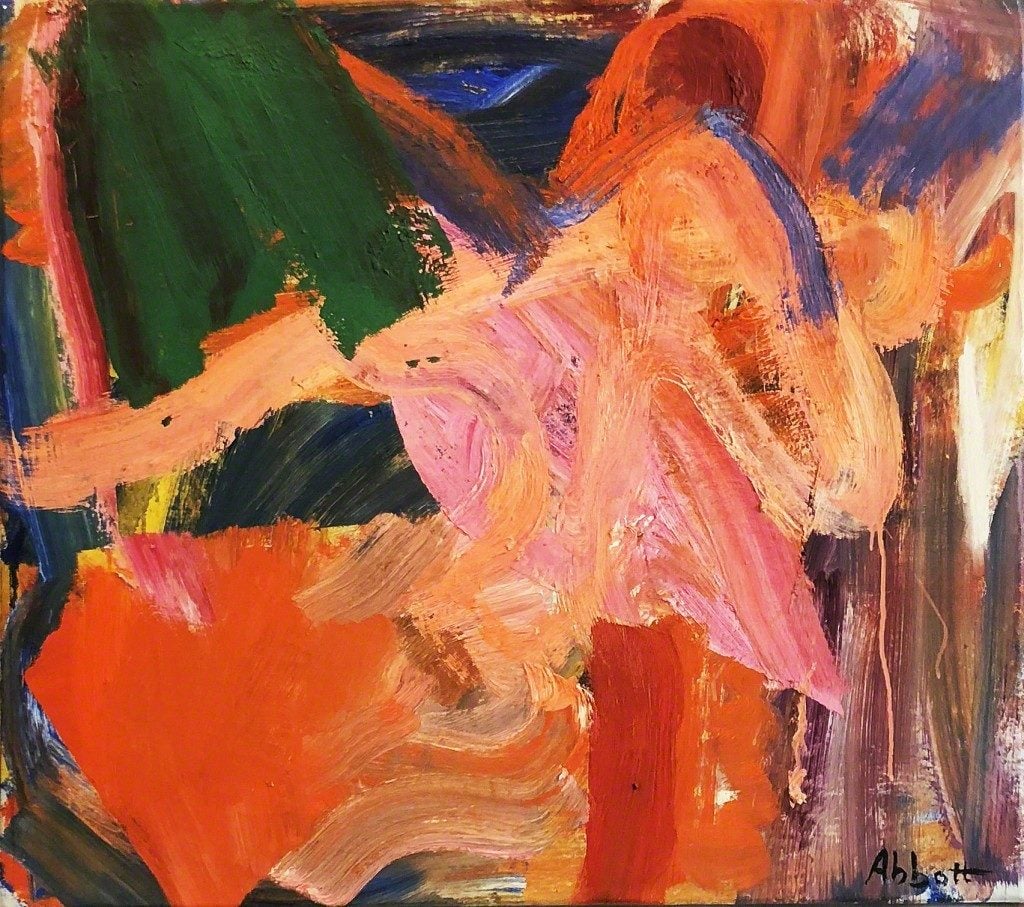
Mary Abbott, Untitled (c.
1955). Courtesy of Mark Borghi Fine Art.
“Mary maintained her home and light-filled studio until her
death,” Denver Art Museum curator Gwen Chanzit, who organized the
2016 exhibition, told artnet News in an email. “A trip to the
Hamptons for me was always a pleasure, especially to visit
with Mary. She often talked about those she’d known and those
important to her work, including Willem de Kooning and David Hare.
She was a gracious host to those of us wanting to learn more about
those important early years of Abstract Expressionism.”
A dearth of Abbott’s work has appeared at auction, according to
the artnet Price Database. There
are just 12 recorded sales, with the high-water mark reaching
$28,125 for the 2008 sale of an untitled, undated work
at Sotheby’s New York. Two of her paintings, Darker Than
Amber and Mahogany Road, set to
be auctioned at Chicago’s Hindman Auctions, carry pre-sale
estimates of just $3,000–5,000 and $6,000–8,000, respectively.
Recent exhibitions of the artist’s work include “Mary Abbott: Paintings,
Collages and Watercolors,” which appeared last fall at Suffolk
County Community College’s Lyceum Gallery.
The post Painter Mary Abbott, a Fixture of New York’s
Abstract Expressionist Movement, Has Died at Age 98 appeared
first on artnet News.
Read more https://news.artnet.com/art-world/painter-mary-abbott-has-died-1647730
Further reading


Leave a comment