
‘We Need to Reinvent the ‘Us”: Kader Attia on How Art Might Help Turn the Tide Against the Far Right
According to artist Kader Attia,
we should all be feeling more emotional right now. That is, if we
are to have any hope of defeating fascism, we better tap into our
feelings, because strong sentiment is a weapon—and one currently
being most effectively harnessed by the far right.
The Berlin-based artist’s
exhibition at Lehmann Maupin, titled “Mirrors of Emotion,” presents
an array of poignant works brimming with passion, sentiment, and
sometimes pain. The ultimate end, he says, is to heal collective
trauma and catalyze action, but the imagery he taps into is not
always positive. The show features, for instance, pictures of
dictators like Adolf Hitler and Joseph Goebbels belting out
hate-filled speeches. There
is also a non-fiction film about police brutality, and another
documentary-based piece about the phenomenon of the “ghost limb,”
which occurs after some has lost an arm or a leg but has the
sensation that it is still there.
Attia and I meet in the courtyard
of his studio in Berlin. It’s hot, and the news of the day is that
Germany’s far-right party, the AfD, is set to make major gains in
the suburb of Berlin (they came in second). The artist has just
arrived from filming for a new work. Inside, his studio is filled
wall to wall with books. He speaks quickly and passionately with an
air of deep concern.
“I am very angry about the left.
I think we have neglected too much because of a certain kind of
snobbery,” says Attia. He argues that, since the 1990s, the left
has abandoned the powerful need for collective healing and
catharsis. “We need to reinvent the ‘us.’ The reason that fascism
is rising everywhere is not only because we are living through a
crisis of democracy, but also because people do not believe the
media, and they do not believe the politicians either. Because
people have abandoned politics, they have turned to spaces like
social media. Far-right politicians have realized this, and they
have figured out that their next El Dorado is here.”
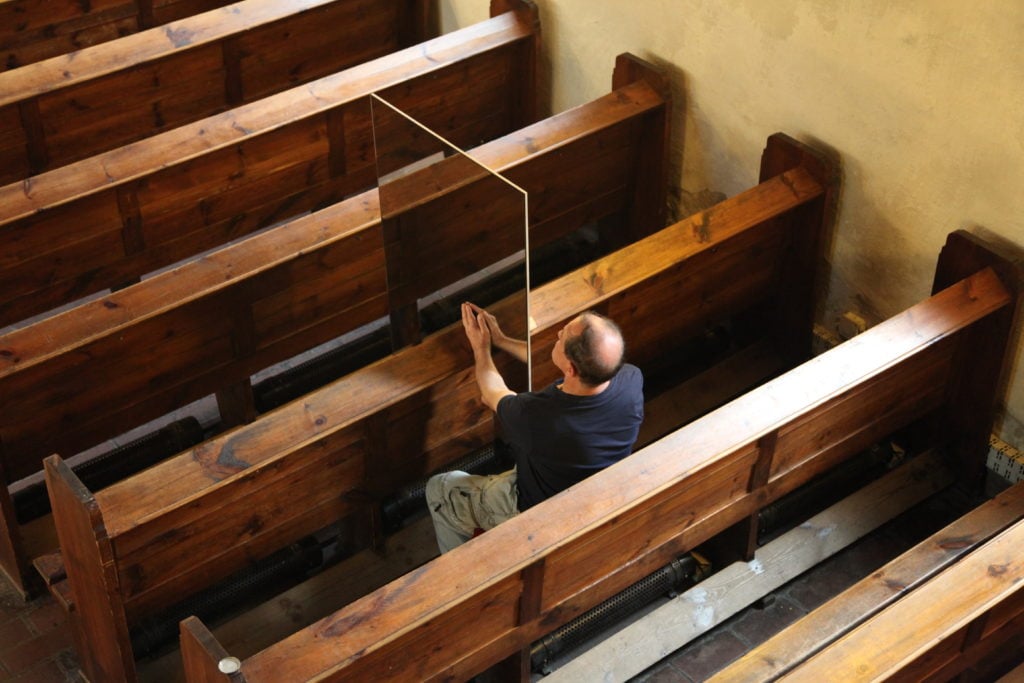
Kader Attia’s Réfléchir la Mémoire /
Reflecting Memory (film still #4), 2016. Courtesy the artist
and Lehmann Maupin, New York, Hong Kong, and Seoul.
Revising the West
Attia is, for most intents and
purposes, a political artist, though that hardly sums up the
breadth of his work. He deals in questions of hegemony, social
injustice, and trauma, and has been recently making work about how
humanity repairs itself. His sculptures often appear to be quippy
juxtapositions of European art canons with overlooked, non-Western
narratives. In an
earlier work called Oil and Sugar, the artist filmed crude
oil pouring over white sugar cubes stacked to look the brick
structure of Mecca, bringing two commodities that have bred
international violence into one singular oozing pile of
mush.
Attia is in a crucial position to
be able to revise the distinctions between the fragile worlds of
the East and West, Europe and the Global South. Born in France to
an Algerian mother, he grew up between the North African country
and Paris, and so the 48-year-old has both an intimate knowledge of
and a critical distance from Western canons.
His unique perspective manifests
in works that invert Western self-understanding: In Untitled
(Ghardaïa) (2009), a scale model of the titular
Algerian city made entirely of couscous, Attia sought to call
attention to the appropriation of Middle Eastern and African
architecture by the modernist architect Le Corbusier, showing the
influence the East actually had on the West, despite the relations
of domination fostered by colonialism.
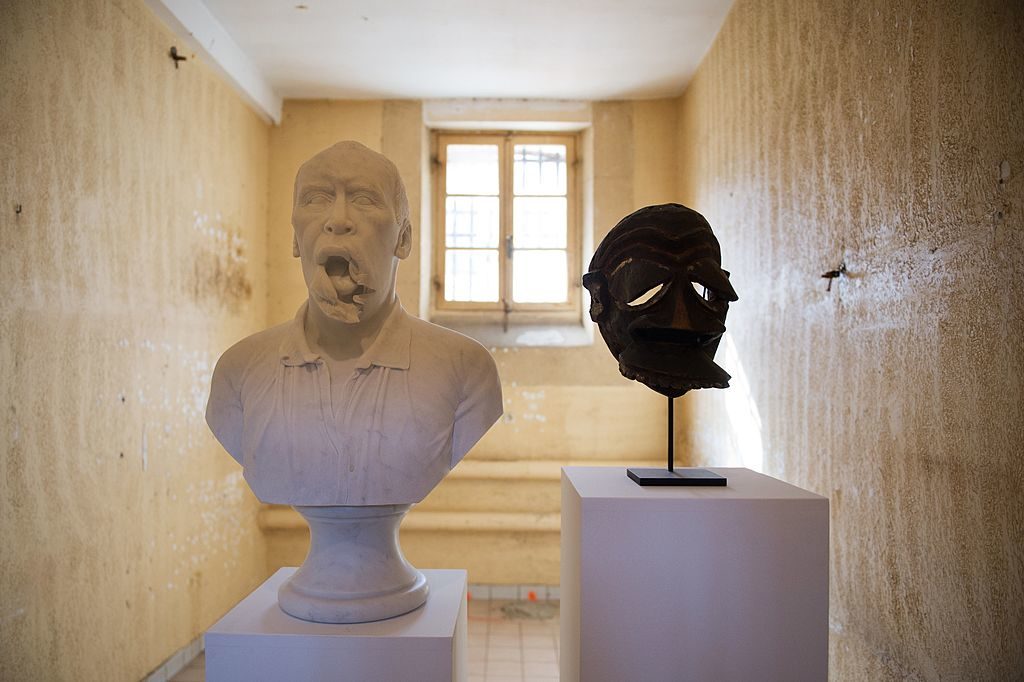
Kader Attia’s Broken Face, Sick
Mask in “The Disappearance of the fireflies” at The Collection
Lambert at the Prison Sainte Anne in Avignon, southern France.
Photo: Bertrand Langlois LANGLOIS/AFP/Getty Images.
What’s even more remarkable is
that Attia has been making art about colonial realities and
post-colonialism well before it became trendy in art. “‘Why are you
working on colonialism?’, I remember some curators asking me.
‘These African countries have their independence, it’s over,’” he
says. “Some galleries did not want to work with me because of my
interest in the subject.”
Today, mainstream art
institutions certainly have caught on. Attia has been featured in
the most visible art shows across the world: the 12th Shanghai
Biennial, the 12th Gwangju Biennial, last year’s Manifesta in
Palermo, the 57th Venice Biennial, and documenta 13, among
others.
But action on political issues
cannot be confined to the art world. Rather, Attia says that
activism is most efficient outside of the contemporary art context.
That is why Attia founded La
Colonie, a space near the
immigrant-rich Gare du Nord in Paris in 2016. It’s also why he
specifically does not what critics to conflate that
gesture with his art practice. “I am not speaking as an artist with
my work at La Colonie. It is not artwork and it will never be. We
need to create spaces where we meet, where we can
disagree.”
Attia argues that, in general,
contemporary art is not the place where the most effective activism
and progress can happen. “The majority of the analysis on
colonialism and post-colonialism is not to be found in artworks,”
he says. “It is in the debate.”
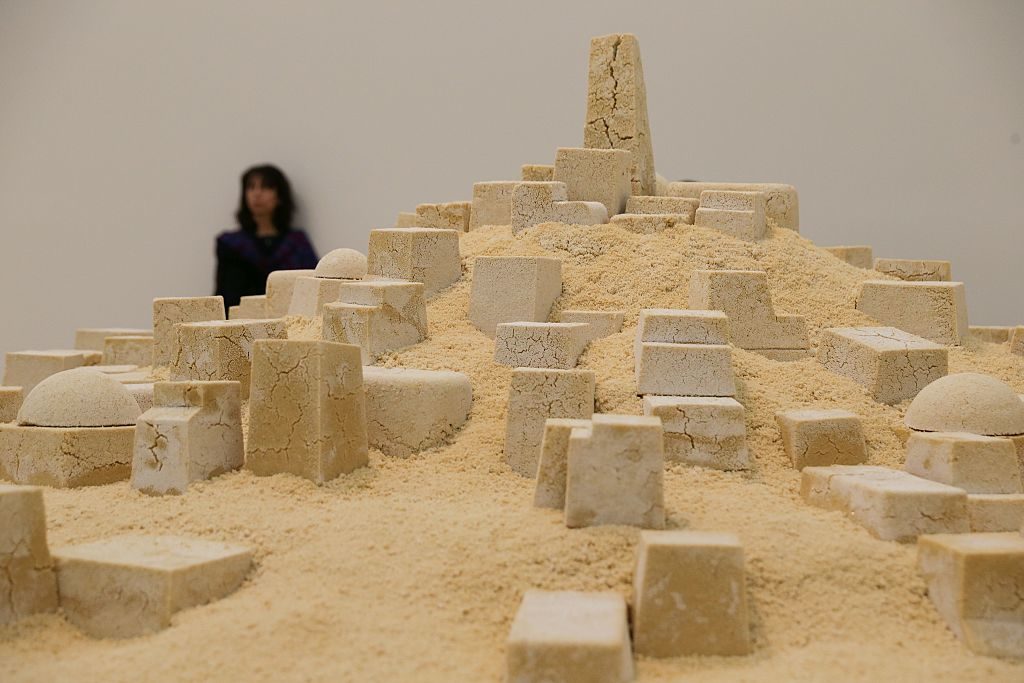
Kader Attia’s ‘Untitled’
(Gharda’a) at the Tate Modern in London. Photo: Daniel
Leal-Olivas/AFP/Getty Images.
Art and Change
I ask him about what some might
see as abuses of the cathartic through contemporary artworks.
Chinese artist-activist Ai Weiwei, for instance, received scathing
remarks when he posed as the drowned three-year-old Alan Kurdi, who
died off of the Greek coastline in 2015. Earlier this year, a
shipwrecked migrant boat that killed over 700
people was installed by
Christoph Büchel at the
Venice Biennale with not even a sentence of context or
explanation.
“Some artists are perhaps working
in a process of recycling pain. That is a dangerous weakness of
contemporary art and it’s just a dead end,” says
Attia.
His films, which are often up to an hour, challenge viewers to
really sit with their subject matter. One work at Lehmann Maupin delves into the
particular situation of racism in France. In The Body’s Legacies, Part 2: The Postcolonial
Body, Attia interviews
Théo Luhaka, a young man who was beaten and sexually assaulted by
French police in 2017 when he was just 22, as well as others
connected to that brutal case.
“The biggest problem that we have
in France is that the left is not decolonial,” Attia says. “Many
people do not understand that this is not just about the Algerian
war and the Gulf war. This is about our universities, about issues
of equality between men and women, between white and
black.”
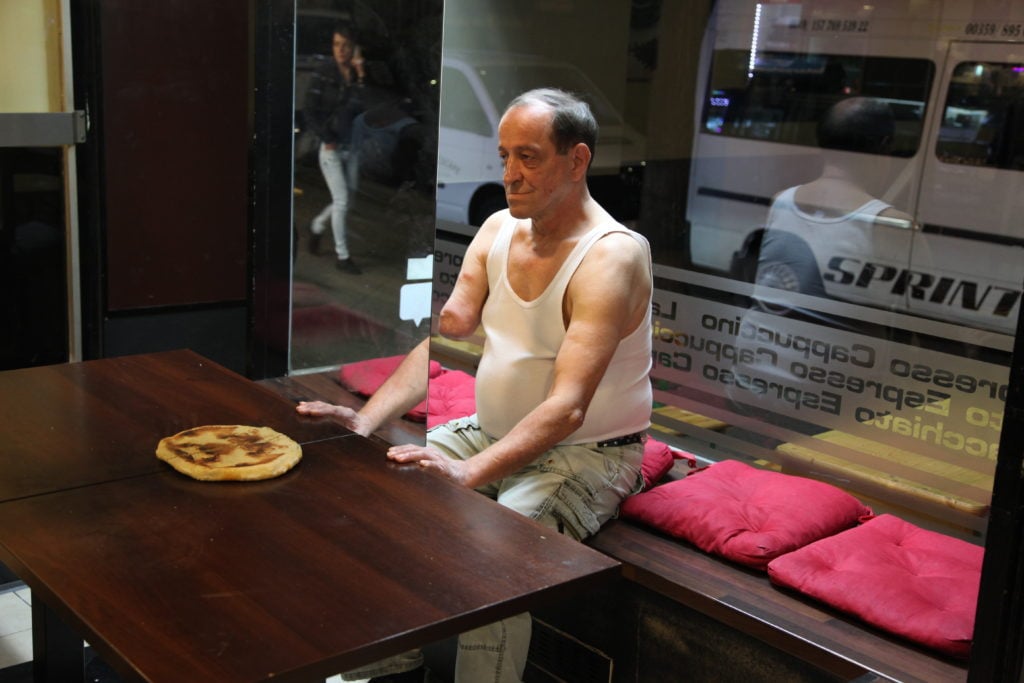
Kader Attia’s Réfléchir la Mémoire /
Reflecting Memory (film still #1), 2016. Courtesy the artist
and Lehmann Maupin, New York, Hong Kong, and Seoul.
At Lehmann Maupin, Attia’s wall
of dictators and fascists is juxtaposed with the faces of famous
and beloved performers. Billie Holiday, Edith Piaf, and Belgian
singer Jacques Brel are coupled with faces representative of the
deepest, most destructive forms of historical trauma. Attia calls
the work The Field of
Emotion.
“What, in mankind, has been able
to compete with the magnetism of fascism? Artists,” says Attia.
“It’s in human nature that we need someone who is the incarnation
of someone we love and someone we hate.”
Inside his studio he pulls out a
photocopied image showing someone in the audience at a concert,
clutching his head and weeping with emotion. The expression is so
intense as to be ambiguous. This is why Attia thinks that music,
dance, and performance are the best formats for catalyzing the
collective. Each of these forms offers a shared experience of being
present among others, in a shared moment.
“There is a sort of logic in the
world we are living in today,” continues Attia. “I really trust
that art can bridge something that the left was not able
to.”
The post ‘We Need to Reinvent the ‘Us”: Kader Attia on How
Art Might Help Turn the Tide Against the Far Right appeared
first on artnet News.
Read more https://news.artnet.com/art-world/kader-attia-lehmann-maupin-1645648
Further reading


Leave a comment