
Shoe Designer to the Stars Christian Louboutin on How Warhol Inspired His First Red-Soled Heel and Why He Calls Himself an ‘Applied Artist’
What shoes should one wear to
meet Christian Louboutin?
That’s what I was wondering as I
made my way to interview the designer behind the red-soled heels
favored by celebrities and royalty, and who is now the subject of a
sweeping exhibition at the Palais de la Porte Dorée in
Paris.
The show, titled
“L’Exhibition[iste],” contains more than 400 pairs of shoes, from
Louboutin’s early designs through the nascence of the iconic red
sole to his more recent “unwearable” sculptural shoes. It’s a
testament to his career as a designer, but at the same time,
Louboutin tells Artnet News, the exhibition had to be about “more
than just shoes.” (Hopefully that means he forgave my hasty 5
a.m. decision to wear scruffy boots to our
meeting.)
“The shoes are the tip of the
iceberg,” Louboutin says. “A lot of things came before
that.”
Indeed, the show includes
biographical elements relating to the designer, as well as new
installations from contemporary artists including Imran Qureshi and
Lisa Reihana. At the end of the exhibition, the designer has put
together what he calls his “imaginary museum,” a selection of
artworks, ranging from tribal masks to pop art, that represent some
of his own artistic inspirations.
![Exhibition view, Christian Louboutin: "L’Exhibition[niste]," Palais de la Porte Dorée. ©Marc Domage.](https://news.artnet.com/app/news-upload/2020/02/Exhibition-view-Christian-Louboutin-L%E2%80%99Exhibitionniste-Palais-de-la-Porte-Dore%CC%81e-%C2%A9-Marc-Domage-3-1024x698.jpg)
Exhibition view, “Christian Louboutin:
L’Exhibition[niste],” Palais de la Porte Dorée. ©Marc Domage.
choice for the Palais Dorée, which is home to the national museum
of the history of immigration. The museum’s executive director, Hélène Orain,
explains that an exhibition about fashion was a good opportunity in
a time when museums are actively seeking to broaden their audience.
“Shoes are a universal language,” she says.
In the works for three years,
the show was curated by the director of Paris’s Musée des Arts
Décoratifs, Olivier Gabet, who agrees with Orain about the
“universal impact” of fashion.
“It brings together artistic and
social values, a kind of paradoxical inclusiveness—it seems
reserved to an elite, but it is a dream for all—and a strong sense
of openness to all,” Gabet tells Artnet News. He says this is
particularly important when more and more people are feeling
alienated by inaccessible museum shows.
“So many artworks, especially in
contemporary art, or very classical art, are nowadays very
difficult to understand for many people, due to the overwhelming
conceptual array of historical and symbolic references which are
sometimes hard to really understand,” he says.
Facing His Fears
Louboutin tells Artnet News that
he grew up nearby the museum in an unassuming working-class
neighborhood, and has been visiting since he was a child. “I owe a
lot to this building,” he says.
Back then, the museum was
dedicated to African and Oceanic Art, most of which has since
migrated to the Quai Branly museum. The Art Deco building was
originally built in 1931 for a colonial exhibition in Paris, and it
shows. The facade features a bas-relief of Africans and French
colonists that today might be read as an offensive relic of
imperialism.
Louboutin admits that as a young
child he was “too scared” to enter the building, but that he was
eventually persuaded by his sister to cross its threshold when he
was around nine years old. He was enchanted by the treasures held
within, from tribal masks to Ancient Egyptian artifacts, and was
utterly taken by the aquarium located in the basement. “It was my
first way to travel before I ever got the chance to do it in real
life, and I was inspired,” he says.
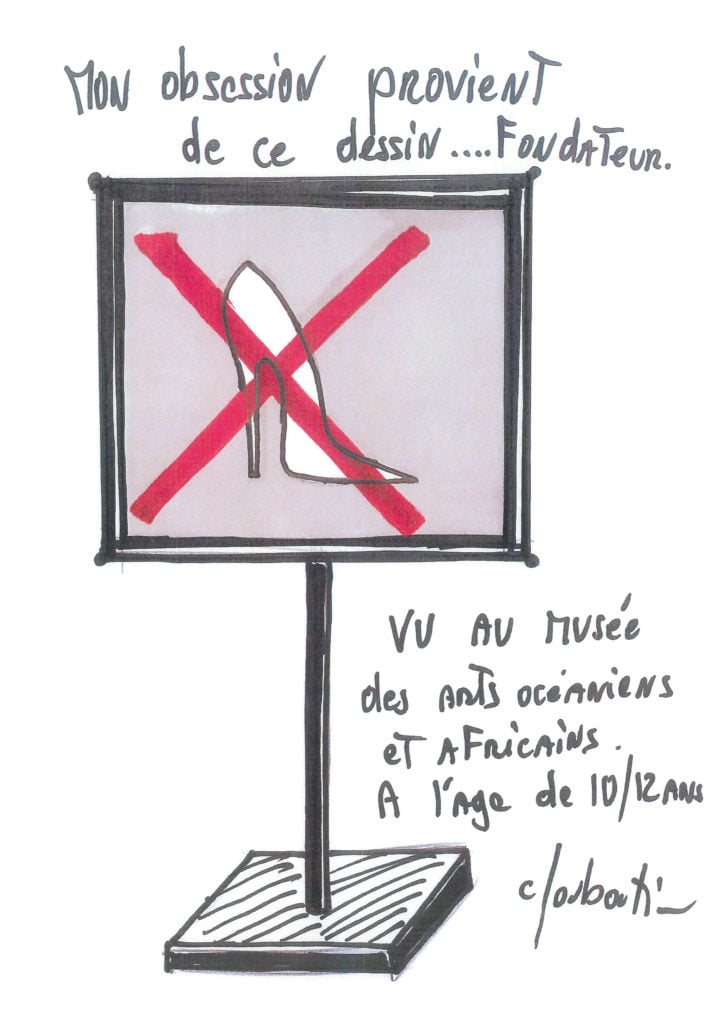
Information panel and crucial drawing at
the origin of Christian Louboutin’s vocation. © Christian
Louboutin.
Indeed, it was inside the museum
that the designer saw his first drawing of a shoe. An outline of a
1950s-style stiletto in profile had adorned a sign forbidding
people to wear high heels in the museum in order to protect the
mosaic floor. The shape of the shoe was unfamiliar to a kid growing
up in the 1970s, and Louboutin credits it with initiating his
vocation.
Artistic Inspirations
The artistic inspirations on
view in the exhibition are rather eclectic, from a selection of
blue and white Wedgwood porcelains to a Damien Hirst work from his
Venice blockbuster to an Oscar Niemeyer bench to Pop art works,
including a piece from Andy Warhol’s “Flowers” series. The first
shoe to be decorated with Louboutin’s signature red sole was
actually a prototype which had a buckle inspired by a Warhol
flower. As the story goes,
Louboutin had a eureka moment when he saw his assistant painting
her nails red. He borrowed the polish to lacquer the sole of the
shoe, and the rest is history.
Asked what types of artworks
inspire him, Louboutin says that it is all about work that can
speak to his “inner child.”
“I’m more attracted by things in
art that are not so mature that they cannot still speak to a
child,” Louboutin says. “There has to be something in the artist’s
world that is accessible.” He says he has always been attracted to
the cartoon-y style of artists like Clovis Trouille and Eyvind
Earle, who was an early illustrator for Walt Disney’s
animations.
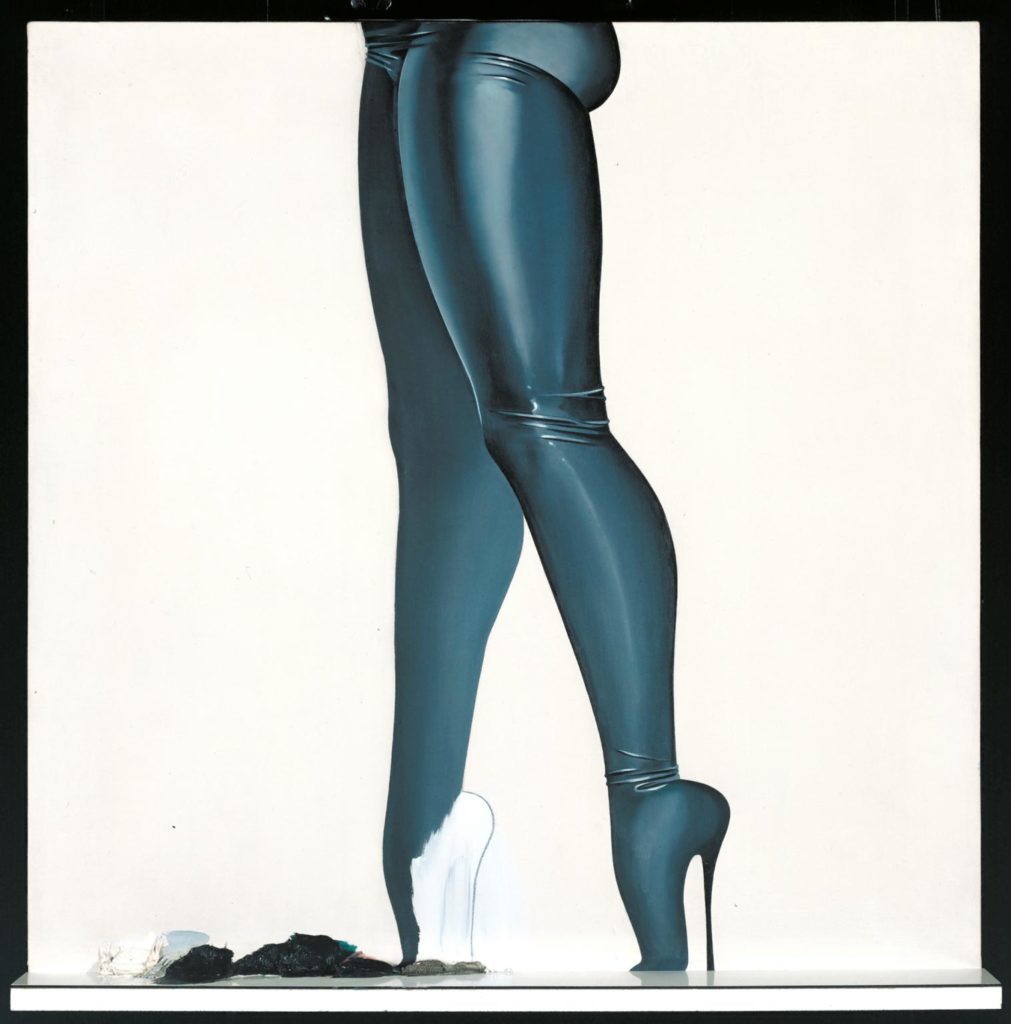
Allen Jones, Wet Seal
(1966).
“I always questioned this
element of respect for big, noble art that depends on it being
detached from any function,” Louboutin says. He talks about the
talent of the Giacometti brothers, and the fact the Diego has
always had less acclaim than his older brother Alberto because he
made “art that you can sit on.”
“I never really understood why having a function for an art
piece makes it any less noble,” Louboutin says.
Louboutin says that he has the
same relationship with shoes as he does with works of art, and he
considers himself to be an “applied
artist.” Some of the
most interesting shoes on view are a series of impossible shoes
that Louboutin made for a collaboration with the filmmaker David
Lynch. The artist photographed women wearing them, a set of
conjoined heels, or pointe shoes with a sky high heel, as part of a
2007 series called “fetish.” These shoes are closer to sculpture
than to functionality, but Louboutin says they shouldn’t
necessarily be considered “art” any more than the shoes he designs
for the red carpet.
Some of the works on view have
come from Louboutin’s own home, but he doesn’t see himself as a
collector. “A collector is someone who wants to perform in a way,
who is pretty obsessed with having a piece which fits into their
collection,” he says, adding that he has never sold anything in his
collection. “Me? If I
like an object or I like a painting, then I might buy it. But it’s
never in reference to another piece, or because I want the best
painting of this other artist. It’s just an instinctive
moment.”
Artistic Freedom
The exhibition includes new
installations from artists including a group of nine leather
mannequins in different skin-tones created by the British artist
duo Whitaker/Malem. There is also a video work by Lisa Reihanna,
stained-glass pieces by La Maison du Vitrail, and a rather shocking
installation by the Pakistani artist Imran
Qureshi featuring a
gold-leaf-clad shoe in what appears to be a pool of
blood.
It’s not exactly the branding
association you would expect to be welcomed by a high-heel
shoemaker. Indeed, Louboutin says he was “surprised” by the result.
They had discussed a vision of red and gold in the beginning of the
collaboration, and he had actually been expecting one of the
artist’s delicate miniatures. But he says that he is not upset that
the artist went in a different direction.
![Imran Qureshi, <i>This too will end, if you go on a step or two</i> (2019). Exhibition view "L’Exhibition[niste]," Palais de la Porte Dorée. ©Marc Domage.](https://news.artnet.com/app/news-upload/2020/02/Imran-Qureshi-This-too-will-end-if-you-go-on-a-step-or-two-2019-Exhibition-view-L%E2%80%99Exhibitionniste-Palais-de-la-Porte-Dore%CC%81e-%C2%A9-Marc-Domage-1024x682.jpg)
Imran Qureshi, This too will end, if
you go on a step or two (2019). Exhibition view
“L’Exhibition[niste],” Palais de la Porte Dorée. ©Marc Domage.
artist, you can’t drive them, otherwise why wouldn’t you just do it
yourself?” Louboutin says. “It started with a conversation and it
went to a place that I was not going to try to contrive or to
direct. If you have the possibility to work with an artist, you
have to let them be free.”
From the runway to the high
street, fashion brands are collaborating more often with artists
who can bring a certain cachet to help define and enrich a brand.
But Louboutin says that any collaboration that he does “needs to be
natural.”
“It needs to be organic. I’ve
never done a collaboration for its own sake,” he says. “I have a
brand, but I have never considered it in this cynical
way.”
While it is all well and good
when an artist does something unexpected as part of a
collaboration, Louboutin admits that it can be “annoying” when an
artist or another brand copies his designs, or uses them in a less
than flattering light.
The company is known for
fiercely protecting its trademark, although Louboutin says that he
personally prefers not to engage with the offenders. “I’m pretty
much an enthusiastic person and a very positive person, so for
everything that is negative, I’m a bit of an ostrich. I’d rather
not look at it,” he says. “That’s sort of my way to not feel too
annoyed by these things, like forms of copy or like trashing
someone else’s work. Sometimes it’s not what you expect around your
work, and I just prefer not to know.”
“L’Exhibition[iste]” runs at
the Palais de la Porte Dorée in Paris through July 26.
The post Shoe Designer to the Stars Christian Louboutin on
How Warhol Inspired His First Red-Soled Heel and Why He Calls
Himself an ‘Applied Artist’ appeared first on artnet
News.
Read more https://news.artnet.com/exhibitions/christian-louboutin-exhibition-paris-interview-1789965
Further reading


Leave a comment