
The Gray Market: Why Endeavor’s Aborted IPO Is—and Isn’t—Like a ‘Burned’ Auction Lot (and Other Insights)
Every Monday morning, artnet
News brings you The Gray Market. The column decodes important stories from the
previous week—and offers unparalleled insight into the inner
workings of the art industry in the process.
This week, following up on my
own thoughts…
BURN NOTICE
On Thursday, yours
truly unpacked what we
could learn about Frieze’s future from the paperwork filed by its
majority owner, Hollywood-agency-turned-media-and-events
conglomerate Endeavor, in its quest to go public the following
morning. But a few days of research and analysis turned out to be
relevant for about seven hours, as word got out by roughly 5:30
p.m. that Endeavor leadership—no doubt under the advisement of a
murderer’s row of underwriters including Goldman Sachs, JP Morgan,
and Morgan Stanley—had decided to delay the IPO until an
undetermined later date.
The postponement now puts
Endeavor into a scenario all too familiar to auction urchins like
me: one in which, despite the best marketing efforts of an
illustrious and properly incentivized intermediary, an alleged
high-value asset is publicly shamed by widespread disinterest among
potential buyers, leaving its owners no choice but to retreat with
a property newly confirmed as unwanted for anywhere near the
advertised price.
Even most market novices know
that any artwork suffering this fate at auction gets branded with
the scarlet label “burned.” The idea is that the consignor might as
well have chucked the piece into a roaring fireplace, since an
unrecognizable slab of carbon would be just as salable as their
freshly bought-in artwork.
Of course, the term “burned” is
an exaggeration. Works that fail to find a buyer at auction often
manage to sell later. But how much later? At what price? And through what avenue?
These questions all burst into legitimacy the moment the chastened
auctioneer murmurs “pass”—and the consignor generally wants to
consider none of them until that ignominious moment
arrives.
Although the answers to those
questions aren’t universal, they do tend to be linked. An owner
desperate for cash might be able to sell a burned artwork
relatively quickly if they’re willing to stomach a steep discount
from the reserve price in a private sale. But if they’re hell-bent
on getting something close to the estimate range, they’re likely
going to have to sit on the work long enough for some
market-changing event to take place. And there’s no telling what
the timeline for that scenario might be.
All of the above gives us a
useful framework to think through what happens next with Endeavor.
But it also clarifies an important way in which the financial
market and auction market differ.
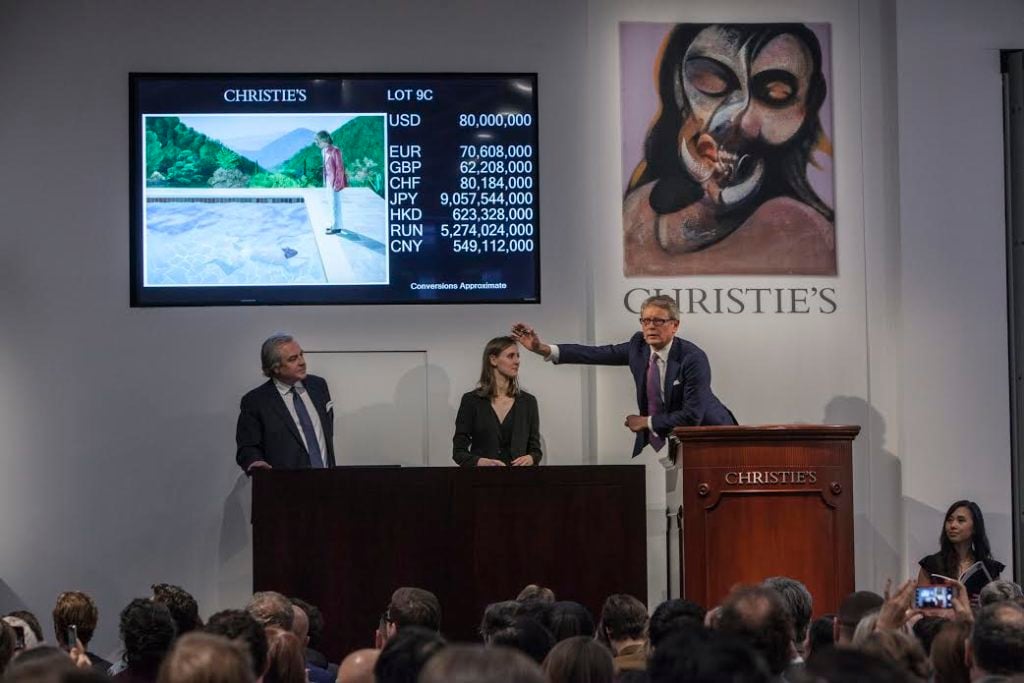
Bidding for David Hockney, Portrait
of an Artist (Pool with Two Figures) , 1972, which was offered
with no reserve price at Christie’s post-war and contemporary
evening sale in November 2018. Courtesy of Christie’s Images
Ltd.
CALLING IN THE FIREFIGHTERS
Thursday evening’s 11th-hour
postponement was actually the second time Endeavor delayed its IPO
this year. The first episode came in early August, when the company
shelved the offering so that it would have a chance to release its
second-quarter financials and complete a $700 million acquisition
of On Location Experiences, LLC, a live-event production and
“curated hospitality” specialist boasting relationships with the
National Football League, the US Tennis Association, and a host of
music stars.
That rationale sounds legit on
the surface. But when Endeavor set the date for IPO 2.0 about two
months later, the deal for On Location still wasn’t finalized,
according to the Wall Street
Journal. Its Q2
results apparently didn’t turn out to be much of an aphrodisiac to
investors, either. Only a few hours before deciding to yank the IPO
altogether, the company actually filed to drop the number of shares
it would offer by 22 percent, as well as reduce the price range
from between $30 and $32 per share to between $26 and
$27.
The latter of these panic moves
also has an analogue in the auction-house playbook. If the house’s
specialists don’t find the level of bidder interest they expected
for works without financial guarantees in the days leading up to a
sale, it’s not uncommon for them to call their consignors and
request permission to lower the reserve price (the unadvertised
minimum price, usually calculated as a percentage of the low
estimate, at which the auctioneer is permitted to sell the
work).
No consignor enjoys taking this
call, since it’s strong evidence that their return on the lot may
be even lower than their most conservative expectations. Still, it
gives them a chance to face up to the old business adage that 75
percent of something is better than 100 percent of
nothing.
In especially dire cases, a
house and a consignor can even agree to pull the artwork from the
sale altogether. Like postponing an IPO, this move is both an
embarrassment and a way to prevent an even more embarrassing
outcome. Technically speaking, the work can’t be burned if you
never actually expose it to the flames.
But here’s where artworks and
IPOs part company—and why recognizing the divergence means more
than just engaging in a thought exercise.
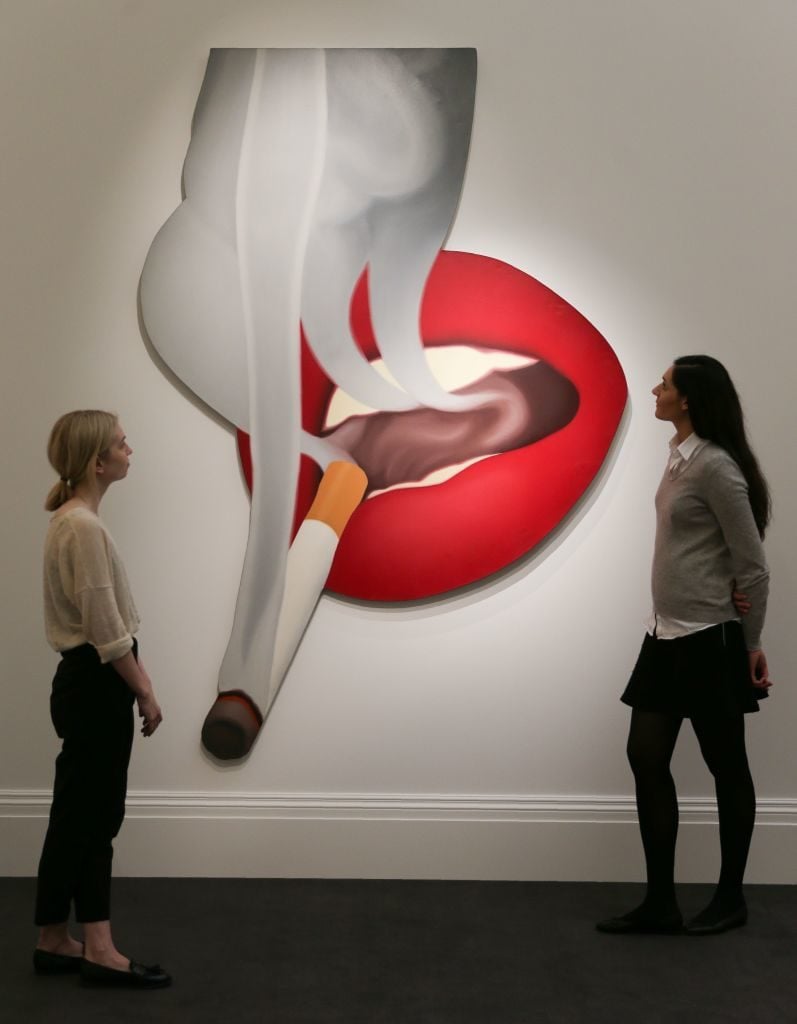
Employees pose with Tom Wesselmann’s
Smoker #5 (mouth #19), at Sotheby’s in 2017. Courtesy of
DANIEL LEAL-OLIVAS/AFP/Getty Images.
SMOKE SIGNALS
Lots preemptively yanked from an
auction are generally treated as if they are materially different
from lots that get bought in. Part of the reason is that the former
group gets entered into a kind of witness-protection program for
artworks, where all records of their presence in the sale are
scrubbed from auction-house websites and omitted from the results
later sent to auction-price databases. Yet in both cases, the owner
and the intermediary misjudged the market badly enough to find
nothing but an empty well where they expected to find a revenue
stream. From the standpoint of market demand, then, we’re talking
about a distinction without a difference.
This is why I think we need a
name for artworks that would have been “burned” if they
hadn’t been secreted away in time for the public not to be able to
see the conflagration. By virtue of their close proximity to the
flames and the way they disappear in an obscuring haze, let’s call
them “smoked” lots.
Savvy dealers, collectors, and
analysts can still manage to sniff out the aroma of smoked lots
when they reappear later. Gossip is forever, and it’s impossible to
retroactively ghost the information in a printed catalogue (if one
exists). But less dedicated observers may be none the wiser, giving
the works’ owners and intermediaries an ethically squishy advantage
if and when they try to return a smoked work to
market.
For all their other problems,
the financial markets are too well-monitored to allow this kind of
nonsense. True, IPOs are substantially rarer and more visible in
the trade media than the tens of thousands of non-guaranteed works
consigned to auction every 12 months. (Fewer than 200 IPOs have
been issued annually every year since 2015, according to analytics
site Statista.) This difference grants smoked works a level
of anonymity that aborted first-time stock offerings can never
realistically enjoy.
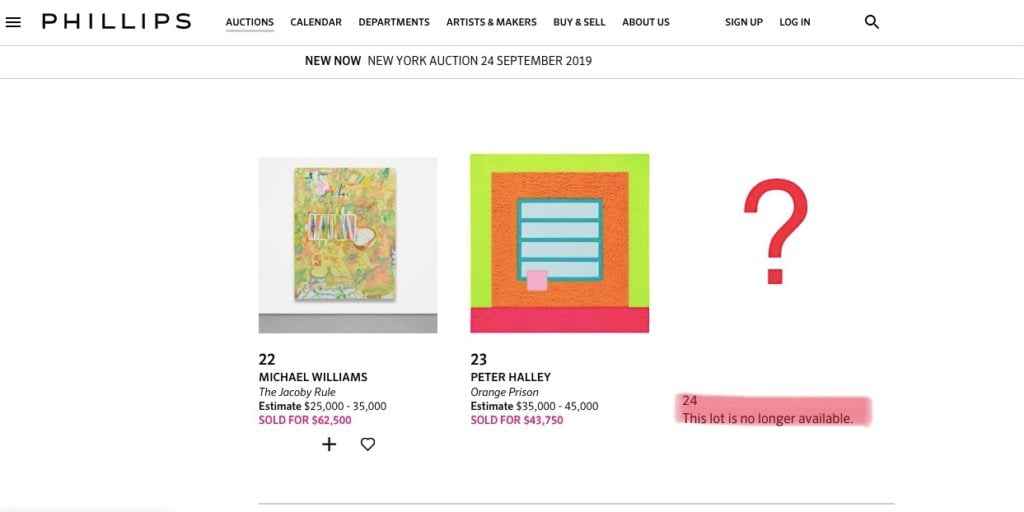
Annotated screenshot of the online
results for the September 2019 “New Now” sale at Phillips New York,
showing the empty space left by a possible “smoked” lot. Courtesy
of Tim Schneider.
But even if this weren’t so,
it’s not as if the US Securities and Exchange Commission would
agree to de-list Endeavor’s S-1 filing (or its many amendments)
once the company delayed its not-so-grand entrance to the New York
Stock Exchange again on Thursday evening. That would qualify as
blatant market manipulation. Endeavor’s competitors and other
adversaries, as well as government and industry watchdogs, would
sue immediately, and I suspect they would have a bulletproof case
in any courtroom outside a Kafka short story.
Now, I’m not recommending the
formation of a government agency to monitor auction sales. That
said, I think Endeavor’s IPO yo-yo does clarify an important way in
which the art market would do well to follow the financial market’s
lead. Smoked artworks may be a short-term benefit to consignors and
auction houses, but they do medium- and long-term damage to the
trade by reinforcing perceptions of distressing inconsistency, if
not outright unscrupulousness, in the eyes of outsiders wary of
entering the market. (Attentive existing buyers tend not to be
super into it, either… unless a work they consigned is the one
being smoked.)
While some sacrifices would be
required, self-regulation could eradicate this problem fairly
easily—that is, if the major auction houses felt incentivized to
enact it. Until that time comes, though, the auction market will
have an inverse relationship to the IPO market in this respect:
every delayed or canceled stock offering will make the financial
markets more trustworthy, while every smoked artwork will make the
art market less trustworthy. And when you’re losing to Wall Street
in the realm of integrity, I’m comfortable saying that it’s time to
re-evaluate.
That’s all for this week. ‘Til
next time, remember: even successful cover-ups come at a
cost.
The post The Gray Market: Why Endeavor’s Aborted IPO Is—and
Isn’t—Like a ‘Burned’ Auction Lot (and Other Insights) appeared
first on artnet News.
Read more https://news.artnet.com/opinion/endeavor-ipo-burned-artwork-1664788
Further reading


Leave a comment