
The Gray Market: Why Online Art Fairs Aren’t Solving the ‘Fairtigue’ Problem (and Other Insights)
Every Monday morning, Artnet News brings you The Gray Market. The column decodes
important stories from the previous week—and offers unparalleled
insight into the inner workings of the art industry in the
process.
This week, thinking that efficiency isn’t enough…
TIME OUT OF MIND
On Wednesday, the 2020 edition of “Art Basel” “opened”—meaning,
of course, that the grim necessities of the ongoing public-health
fiasco forced what is normally the world’s premier European (and
arguably, global) art fair to launch its latest limited-run
e-commerce website. And those in the art industry who are still
fortunate enough to be either employed or running a business with a
legitimate chance at making money in the midst of this absolute
junkyard blaze of a year mostly tried to lean in and make the best
of the infamous New Normal.
However, a brief exchange I had this week got me thinking about
the bigger picture.
Just before the Art Basel viewing rooms went live, someone in
the industry said to me, with a mix of wonder and exhaustion, “Do
you believe that we’re already doing another one of these? So many
virtual fairs!”
To which my response was: You do realize this is the same
fair schedule we’ve been on for years, right? And that until
the past three months, it was actually even more
demanding, because we were all jumping on planes and swanning
around cities and uprooting our lives for a week at a time to be a
part of the tangible versions of these same events?
I don’t want to downplay the practical and psychological
pressures that the lockdown and the national civil-rights uprising
have put on anyone lacking the ability and inclination to retreat
to a scenic country home. Simply surviving every day physically and
mentally intact requires more effort than many of us have put forth
in our lifetime.
It’s also true that the ban on tangible exhibitions and other
IRL events has compelled galleries, fairs, and institutions to
overcompensate with digital stand-ins of all kinds, as my colleague
Nate Freeman covered a
few weeks ago.
That said, there is no earthly way in which clicking around
online viewing rooms is a heavier lift than physically
participating in art fairs.
Is it more frustrating? I’d say yes. By this point, every new
glitch-ridden Zoom meeting pushes me closer to driving a letter
opener through my laptop camera like I’m trying to stake a vampire.
I’d rather spend a full day trying to make sense of 300 physical
art-fair booths sustained by nothing but a Clif Bar than spend a
day switching between browser tabs to look at photos and prices on
a backlit screen inside the same two rooms that contains the rest
of my life. I’m confident I’m not alone in that preference.
At the same time, what we really need to focus on is that this
art-market A/B testing is a trap.
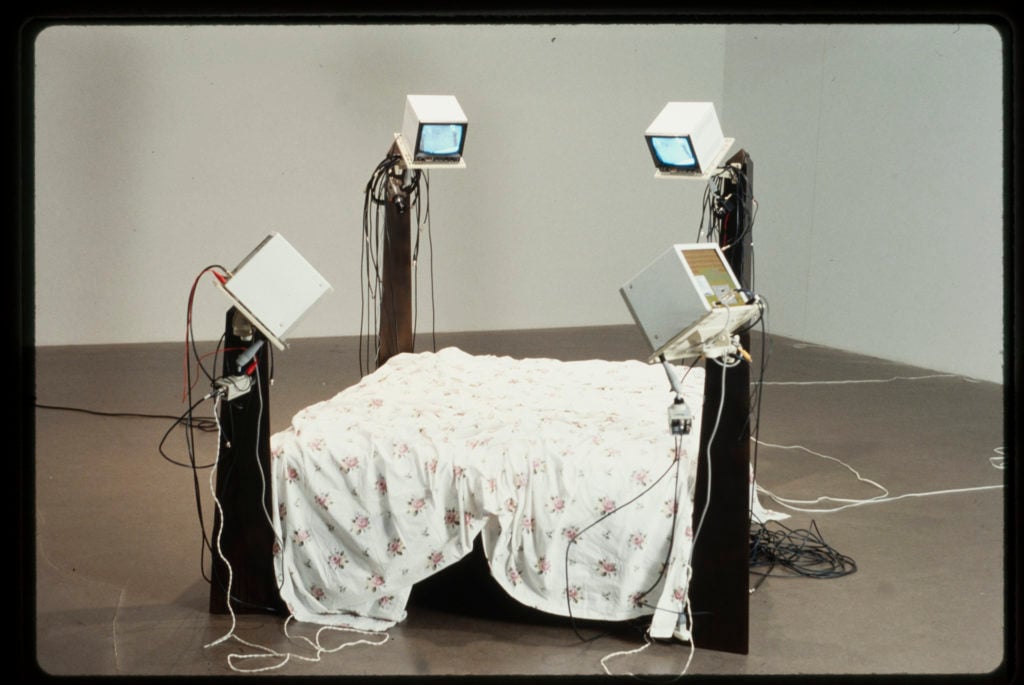
Always There (1994) from Scher’s
Surveillance Beds. Courtesy Esther Schipper.
DRIVEN TO DISTRACTION
Riddle me this: Would you rather be required to swim a full lap
around Manhattan every day in rose water, or in the signature blend
of trash, biological rot, and toxic sludge mucking up the Hudson
and East Rivers?
Obviously, the correct answer is rose water. But weighing those
two choices blinds us to something more fundamental—namely, that
it’s absurd to demand that someone swim a full lap around Manhattan
every day! Changing the details doesn’t make the underlying premise
any more reasonable.
All of the above loops back to the meat grinder of online art
fairs. The common understanding in the Old Normal was that a big
part of what made the art-market calendar so unforgiving was the
nonstop travel. “Maybe if we could just transition some of these
sales events online,” some people thought, “buyers and sellers
could still do much of the same business—only more efficiently and
more pleasantly.”
Well, guess what: the nonstop travel is gone… and most
art-business professionals I know are basically just as exhausted
and overextended as they were before.
In fact, there’s a sense in which the overwhelm feels worse.
Just look at how many galleries are now supplementing their virtual
fair booths with concurrent online sales platforms on their own
websites. As of my writing, Gagosian (which was at the forefront of this
trend) currently has a viewing room at Art Basel through June
24, plus a separate in-house viewing room in which the works being
offered cycle every 48 hours for 10 days. Gladstone has its Art
Basel viewing room, an expanded version on gladstonegallery.com
that includes additional context and artworks, and a separate
in-house viewing room dedicated entirely to watercolors by Ugo
Rondinone, all open for business through June 26.
What does this mean? It means that the travel fatigue was just a
detail, not the unreasonable premise itself.
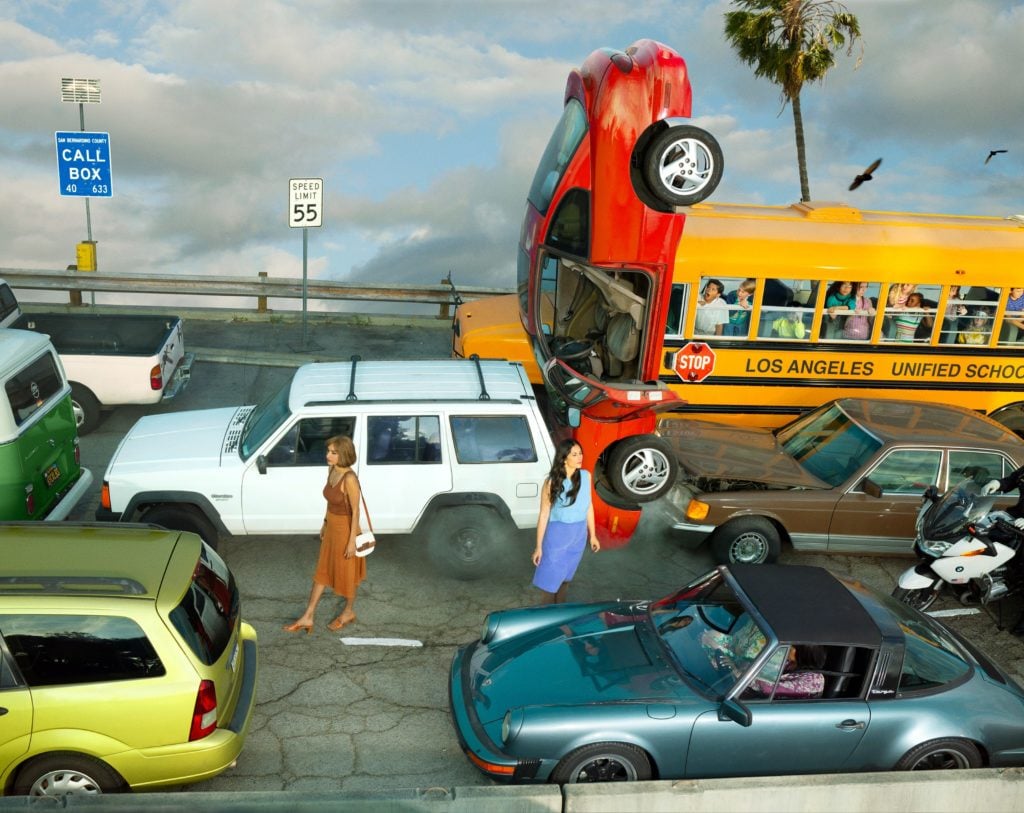
Alex Prager, Speed Limit
(2019). Photo courtesy of Lehmann Maupin.
RACING AGAINST REALITY
In business analysis, it’s become popular to say that the
shutdown is an accelerant. What’s been happening to varying degrees
around the globe is exactly what would have happened without a
lethal medical scourge. Great products would still have sold out.
Dangerously over-leveraged companies would still have gone under.
An appalling amount of taxpayer funds would still have been
legally hijacked from
the Americans most in need by the ones least in need. These
outcomes are just taking mere weeks or months to materialize
instead of years.
What doesn’t get discussed nearly as much is that the same
acceleration is happening in our personal lives, too. If you were
somewhat politically aware before, you’ve probably taken more
direct action in the past few weeks or months than you did in the
past several years. If you thought a dog might be a nice companion
to have back in January, then since May you’ve probably been
willing to fight a bare-knuckle boxing match for the opportunity to
adopt a puppy. If your marriage was starting to buckle in the Old
Normal, then the New Normal has either cracked it clean apart or
left it barely holding together.
The reason is the same: the shutdown has drastically reduced our
options for escaping essential questions. Just like an increasingly
restless couple used to be able to distract themselves from their
base-level incompatibility by meeting up with mutual friends at
their favorite bar for a night, art-fair participants used to be
able to distract themselves from the calendar’s unsustainable pace
by escaping the convention center for an evening to see a great
museum show—or even by tacking on a short vacation to a nearby
destination at the end of a grueling week.
Those opportunities have vanished in the New Normal. What’s left
is just the hamster wheel in its most stripped-down form.
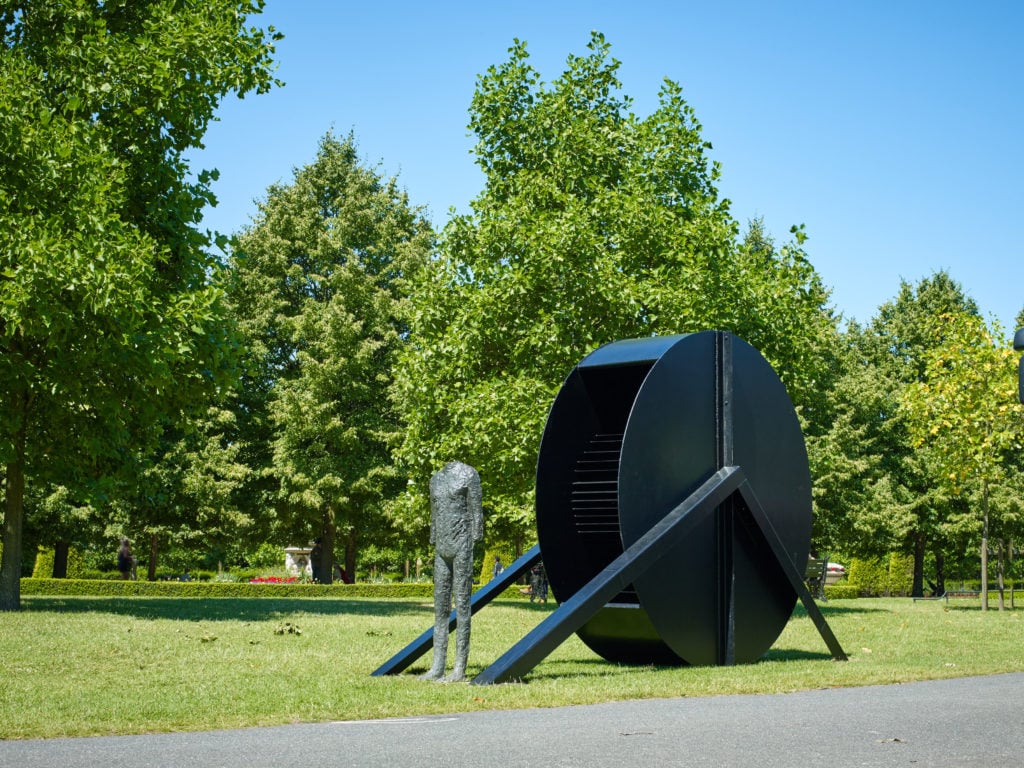
Magdalena Abakanowicz, Standing
Figure with Wheel (1990). Courtesy Marlborough Fine Art. Photo:
Stephen White.
As a smart dealer I talked to this week pointed out, the effect
is amplified by the fact that the entire art fair is now being
channeled through the same access point: the screen. For example,
if an exhibitor didn’t care about the fair’s program of panel
discussions before, the venue for the talks was so far removed from
the trading floor that they could easily forget it even
existed.
Now that the schedule and the events are being broadcast through
the same digital interface as the parts of the event that actually
concerns them, though, they found themselves asking… Wait, why does
the fair need to do these again? And why are my booth fees
subsidizing the cost?
The questions only get more urgent when the same device mediates
not just the entire art fair, not just the entire art market, not
just (nearly) your entire profession, but also most of your
personal life. Line up so many components next to each other in one
repository like this, and you start finding out what has value to
you—and what doesn’t—even if you didn’t particularly want to. And
the answers may scare you.
Look, I might be in the minority here, or at the very least
being swayed by conversations happening in an echo chamber. I just
think that if we believe that we can meaningfully ease the
punishing demands of the 21st century art market
simply by rebalancing the proportion of online versus offline
events, we’re kidding ourselves.
More and more of the art world is inching out of lockdown every
week. Galleries in New York were permitted to reopen by appointment last Monday,
and a group of dealers in Berlin installed actual gallery shows of the works
they were presenting on Art Basel’s sales platform. Although
legitimate fears of a public-health relapse loom (setting aside
that the US’s curve has plateaued, not
flattened), the Old Normal hasn’t felt so reachable in months.
Regardless of when the shutdown finally ends for good, let’s see
how many of the industry’s decision-makers exit it agreeing that
more dramatic changes are needed to make the annual calendar
sustainable—and more importantly, what they decide to do about
it.
That’s all for this week. ‘Til next time, remember: When you’re
sheltering in place, there’s nowhere to hide from hard truths.
The post The Gray Market: Why Online Art Fairs Aren’t
Solving the ‘Fairtigue’ Problem (and Other Insights) appeared
first on artnet News.
Read more https://news.artnet.com/opinion/gray-market-online-viewing-rooms-fairtigue-1888735
Further reading


Leave a comment